Sunday, June 8, 2014

The wages of indolence, impotence and incompetence

The wages of indolence, impotence and incompetence

By MARTIN SHERMAN

As disappointing as the response of the West to the Hamas-backed PA government is, Israel bears much of the blame for the situation.

Palestine, with the boundaries it had during the British Mandate, is an indivisible territorial unit... The partition of Palestine in 1947, and the establishment of the State of Israel, are entirely illegal, regardless of the passage of time. 

– The Palestinian National Covenant, as posted on the official Palestinian UN website.

Goal: Complete liberation of Palestine, and eradication of Zionist economic, political, military and cultural existence... Armed struggle is a strategy and not a tactic, and the Palestinian Arab People’s armed revolution is a decisive factor in the liberation fight and in uprooting the Zionist existence, and this struggle will not cease unless the Zionist state is demolished and Palestine is completely liberated. 

– The Fatah Constitution 

Israel will remain erect until Islam eliminates it as it had eliminated its predecessors... The Day of Judgment will not come about until Muslims fight the Jews (killing the Jews), when the Jew will hide behind stones and trees. The stones and trees will say O Muslims… there is a Jew behind me, come and kill him.... Israel, by virtue of its being Jewish and of having a Jewish population, defies Islam and the Muslims.

– The Hamas charter 

In April, Fatah and Hamas reached a reconciliation accord, after a bloody rift of over seven years. This week, subsequent to that agreement, a joint Fatah-Hamas government was established. Almost immediately, the US and the EU announced that they will engage and fund the new government.

Manifestly myopic 

These announcements from Washington and Brussels comprise the latest link in the long chain of humiliating, but entirely foreseeable, foreign policy debacles Israel has experienced under the last two Netanyahu governments.

This abysmal sequence began in June 2009, when at Bar-Ilan University, Netanyahu reneged on electoral pledges and accepted – albeit with evident reticence and reluctance – the admissibility of a Palestinian state. True, he did attempt to hedge his acceptance with unconvincing and unattainable reservations.

But that did little to contain the massive damage his ignominious climbdown caused. In a stroke, the strategic structure of the dispute had been transformed from whether or not there should be a Palestinian state, to what sort of Palestinian state there should be.

Just how manifestly myopic this decision was soon became apparent.

It proved to be a point of singularity in the conflict, for it signaled that the Jews have conceded defeat and, in effect, acceded to the Arab perspective.

All that remained for Israel were vain attempts at rearguard action and desperate damage control. Its position had become untenable – having agreed to something in principle that it could not agree on in practice.

For having conceded, in principle, on the issue of Palestinian statehood, it was left to haggle over the practical details of the process for its implementation.

This set in motion a dynamic in which Israel could not win. For unless it agreed, in practice, to implement what it had agreed to in principle, it inevitably appeared – or was made to appear – obstructionist, being either unreasonable or disingenuous.

No matter how many concessions it made, or how intransigent the other side was, Israel was made to look at fault.

Cavalcade of concessions 

Soon Israel found itself forced to make concession after concession, humiliation after humiliation. No position, however firmly stated, was maintained. Israeli capitulation to Arab demands became the accepted – and expected – norm.

None of these, however far-reaching, was ever considered adequate. None of them was perceived as a token of genuine goodwill – only as a sign of weakness and an invitation for more pressure for greater and more far-reaching concessions.

Thus after accepting the possibility of a Palestinian state, Netanyahu was induced to order an unprecedented 10-month building freeze in the Jewish communities across the pre-1967 lines, excluding Jerusalem. This, however, elicited no response from the Palestinian side, other than a petulant demand to renew the freeze, just when it was about to expire.

It also set the scene for a carefully choreographed row between Israel and the Obama administration, over an announcement made during a visit by Vice President Joe Biden to Israel of a routine bureaucratic approval for an interim planning stage for future construction in the Jerusalem neighborhood of Ramat Shlomo, which, in any case, was not subject to the freeze.

But as before, once the principle is conceded, the details are of little import and the prime minister was subjected to a harrowing 45-minute harangue by then-secretary of state Hillary Clinton, berating him for “insulting the United States” and sending “a deeply negative signal about Israel’s approach to the bilateral relationship.”

Cavalcade (continued) 

 Minor and petty humiliations followed – such as Biden deliberately showing up 90 minutes late for dinner at Netanyahu’s home, or the prime minister and his aides being snubbed and abandoned by Barack Obama during a meeting in the White House.

So instead of being commended for going so sharply against his political base, Netanyahu was condemned and demeaned.

But more was to follow. At Obama’s bidding during his 2013 visit to Israel, Netanyahu made an abject apology to vehemently anti-Israel Islamist Turkish Prime Minister Recep Tayyip Erdogan for the Mavi Marmara incident – even offering compensation for Israeli naval commandos’ use of lethal force to defend themselves against a frenzied lynch mob, trying to violate a legitimate maritime quarantine of the Judeocidal terrorist regime in Gaza.

The only tangible consequence of this dishonorable gesture has been arrest warrants for senior Israeli officers issued by a Turkish court.

Then came the Kerry initiative, and once again a Netanyahu-led government bowed to pressure, making concessions most of its ministers built their political careers opposing.

Astonishingly, a government stacked with alleged territorial hawks not only agreed to enter into negotiations on Palestinian statehood, whose agreed (albeit tacit) point of departure was the indefensible 1967 “Auschwitz borders,” it capitulated even further.

To cajole the Palestinians into deigning to participate in talks – which one would have thought they had a greater interest in conducting than Israel did – Israel agreed to the release of scores of convicted terrorists, guilty of the most heinous acts of brutality.

The futility of flexibility 

Yet despite all this far-reaching “flexibility,” not a single conciliatory gesture from the Palestinians was forthcoming. Obdurately, they clung to their most radical and uncompromising positions. True to the principles laid out in the founding documents of their major constituent organizations (see introductory excerpts) they even refused to acknowledge that the Jews have any right to self-determination or political sovereignty – “regardless of the passage of time.”

So, as anyone with half a brain could have predicted with ease, the ill-conceived Kerry initiative reached an impasse – and subsequently collapsed.

Having wrung all feasible concessions from Israel, the allegedly moderate Fatah (whose constitution commits it to the destruction of the Jewish state in the name of the“Palestinian Arab People’s armed revolution”) joined in a unity agreement with the supposedly more extreme Hamas (whose national charter commits it to the destruction of the Jewish state in the name of Islam).

Yet despite all this manifest Israeli willingness to compromise and concede, and the equally manifest Palestinian intransigence, Israel is being portrayed as responsible for the failure of the ill-fated endeavor.

Thus, in a recent interview conducted with Netanyahu, Bloomberg’s Jeffrey Goldberg, considered by some as Obama’s court scribe, once again displayed his extraordinary penchant for bias and cavalier disregard for facts.

With breathtaking gall, he writes in the preamble to his interview: Right now, the burden is on Netanyahu to prove that he is interested in compromise” 

Really, Jeffrey?...

Forked tongues at Foggy Bottom? 

Initially, the US reaction toward the Fatah- Hamas pact seemed uncharacteristically sensible.

Thus, in April, US State Department’s spokeswoman Jen Psaki announced that “Washington was disappointed by the announcement,” and warned it could seriously complicate peace efforts. She added what should be a self-evident truth: “It’s hard to see how Israel can be expected to negotiate with a government that does not believe in its right to exist.”

But this rare lapse into common sense was, as expected, short-lived. The PC (Palestinian- compliant) gobbledygook soon reasserted itself – for, clearly, to acknowledge stark political truth, as opposed to seductive political correctness, entailed a cost too onerous to contemplate: admission that the two-state solution was no longer a feasible option.

Accordingly, following the formation of the Fatah-Hamas government, Psaki’s tune changed dramatically: “We will be judging this government by its actions. Based on what we know now, we intend to work with this government…,” which seems to strongly suggest that, suddenly, it really wasn’t all that “hard to see how Israel can be expected to negotiate with a government that does not believe in its right to exist.”

Similar sentiments were conveyed by the EU’s top envoy to the US, Joao Vale de Almeida, who declared that Europe was prepared to work with a government backed by Hamas: “We never said we would not. It’s a question of substance rather than the question of composition of the government.”

This of course leaves us to puzzle over what possible basis there is for any hope that a Palestinian government, backed by Hamas, will be capable of behaving in any way more conducive of an agreement with Israel than one that is not backed by it.

Wages of indolence, impotence incompetence 

But it also underlines the fact that, in the eyes of its purported allies, there is no concession that Israel can make that would be considered generous enough; no principle crucial enough to justify Israel adhering to it. Conversely, it seems there is nothing that the Palestinians can do, say or write that is egregious or abhorrent enough for politicians and bureaucrats in Washington or Brussels to disqualify them as appropriate interlocutors for peace.

So in effect by accepting the admissibility of Palestinian statehood, Israel has fostered a situation in which it will be only a matter of time until Hamas is “sanitized” as a worthy participant in negotiations on the future of the Jewish state, to whose destruction it is committed.

But, as disappointed as Israel may be with the response of the West, it must bear much of the blame for the circumstances it finds itself in. Through its indolence, impotence and incompetence it has allowed the Palestinian narrative to dominate the discourse.

It has been appallingly remiss in mobilizing the resolve, resources and resourcefulness needed to discredit the authenticity of demonstrably (indeed, openly admitted) false Palestinian claims for nationhood, peoplehood and statehood. It has been derelict in not devising mechanisms to mobilize the massive pools of latent public support for Israel around the world and in allowing Palestinian fabrications to mold public perceptions of the Israel-Palestinian conflict.

Ignoring political ‘logic’ 

Clearly, within the context of conventional wisdom, the contention that Israel’s acceptance of the legitimacy of Palestinian national claims laid the foundations for its current predicament seems counter-intuitive, to many observers.

However, the logic is unassailable and the conclusion to which it leads inexorable: Once the legitimacy of a Palestinian state is conceded, the delegitimization of Israel is inevitable. The chain of reasoning is clear and compelling – almost algorithmic:

• If the Palestinian narrative which portrays the Palestinians as an authentic national entity is acknowledged as legitimate, then all the aspirations, such as achieving Palestinian statehood, arising from that narrative are legitimate.

• However – in the absence of wildly optimistic, and hence irresponsibly unrealistic, best-case assumptions – any policy that is designed to secure Israel’s minimal security requirements will preclude the establishment of a viable Palestinian state.

• Consequently, any endeavor to realistically provide Israel with minimal security will be perceived as illegitimate. By accepting the admissibility of a Palestinian state, one necessarily admits the inadmissibility of measures required to ensure Israeli security.

• The inevitable conclusion must, therefore, be that for Israel to secure conditions that adequately address its minimal security requirements, the Palestinian narrative, and the aspirations that flow from it, must be disqualified.

Until there is a government that can internalize this necessary, albeit unpalatable truth, and formulate policy that reflects it exigencies, the Zionist endeavor and the survival of the Jewish nation-state will be increasingly menaced.

Martin Sherman is the founder and executive director of the Israel Institute for Strategic Studies.

www.martinsherman.net

http://www.jpost.com/Opinion/Columnists/Into-the-fray-The-wages-of-indolence-impotence-and-incompetence-355504

Palestinian Leaders Don't Want an Independent State

Palestinian Leaders Don't Want an Independent State

by Efraim Karsh

The Palestinian leadership's serial rejection of the numerous opportunities for statehood since the Peel Commission report of 1937 casts a serious doubt on its interest in the creation of an independent state. Instead of engaging in the daunting tasks of nation-building and state creation, all Palestinian leaders without any exception—from the Jerusalem mufti Hajj Amin Husseini, who led the Palestinian Arabs from the early 1920s to the late 1940s; to Yasser Arafat, who dominated Palestinian politics from the mid-1960s to his death in November 2004; to Mahmoud Abbas—have preferred to immerse their hapless constituents in disastrous conflicts that culminated in their collective undoing and continued statelessness. At the same time, of course, these leaders have lined their pockets from the proceeds of this ongoing tragedy.

It can be shown that the main sources of this self-destructive conduct are pan-Arab delusions, Islamist ideals, and the vast financial and political gains attending the perpetuation of Palestinian misery.

Pan-Arab Delusions


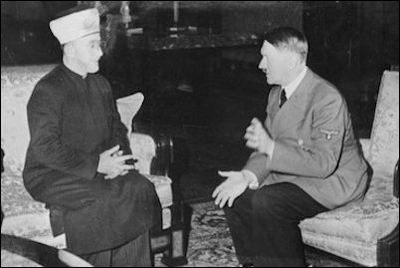
Jerusalem mufti Hajj Amin Husseini (left), in one of his letters to Hitler (right), did not speak of Palestinian aspirations, but rather, pan-Arab goals: "[T]he Arab people … confidently expects that the result of your final victory will be their independence and complete liberation, as well as the creation of their unity, when they will be linked to your country by a treaty of friendship and cooperation."
In discussions of the history of the Arab-Israeli conflict, it is rarely acknowledged that, as products of the Ottoman imperial system where religion constituted the linchpin of the sociopolitical order of things,
Palestinian Arab leaders during the British mandate era (1920-48) had no real grasp of the phenomenon of nationalism, hence, had no interest in the evolution of a distinct Palestinian nation. Instead they were wedded to the pan-Arab dream of a unified "Arab nation" (of which "Palestine" was but a tiny fragment) or the associated ideology of Greater Syria (Suriya al-Kubra), stressing the territorial and historical indivisibility of most of the Fertile Crescent.

As early as October 1919, Musa Kazim Husseini, a former Ottoman official, elected Jerusalem mayor under the British, told a Zionist acquaintance that "we demand no separation from Syria."[1] Six months later, in April 1920, his peers instigated the first anti-Jewish pogrom in Jerusalem—not in the name of Palestine's independence but under the demand for its incorporation into the (short-lived) Syrian kingdom headed by Faisal ibn Hussein of Mecca, the celebrated hero of the "Great Arab Revolt" against the Ottoman Empire and the effective leader of the nascent pan-Arab movement. Four years later, in a special report to the League of Nations, the Arab Executive Committee (AEC), the umbrella organization of the Palestinian Arabs, still referred to Palestine as the unlawfully severed southern part of "the one country of Syria, with its one population of the same language, origin, customs, and religious beliefs, and its natural boundaries."[2] And in June 1926, the league's permanent mandates commission was informed of an Arab complaint that "it was not in conformity with Article 22 of the Mandate to print the initials and even the words 'Eretz Israel' after the name 'Palestine' while refusing the Arabs the title 'Surial Janonbiah' ['Southern Syria']."[3]

In July 1937, the Arab Higher Committee (AHC), the AEC's successor, justified its rejection of the Peel Commission's recommendation for the partition of Palestine on the grounds that "this country does not belong only to [the] Palestine Arabs but to the whole Arab and Muslim Worlds."[4] As late as August 1947, three months before the passing of the U.N. resolution partitioning Mandate Palestine into Arab and Jewish states, the AHC's mouthpiece al-Wahdaadvocated the incorporation of Palestine (and Transjordan) into "Greater Syria."[5]

Hajj Amin Husseini himself never acted as a local patriot seeking national self-determination but rather as an aspiring pan-Arab regional advocate. An early admirer of the "Greater Syrian" ideal, he co-edited the Jerusalem-based newspaper Suria al-Janubiyya and presided over the city'sArab Club, which advocated Palestine's annexation to Syria. He cast his sights much higher after fleeing the country in 1937 to avoid arrest by the British for the instigation of nationwide violence: Presenting himself to Hitler and Mussolini as a spokesman for the entire "Arab nation," Husseini argued that the Palestine problem necessitated an immediate solution not because of the national aspirations of the Palestinian Arabs but because it constituted "an obstacle to the unity and independence of the Arab countries by pitting them directly against the Jews of the entire world, dangerous enemies, whose secret arms are money, corruption, and intrigue." His proposed solution, therefore, was not Palestinian statehood but "the independence of [unified] Palestine, Syria, and Iraq" under his leadership. As he put it in one of his letters to Hitler, "[T]he Arab people, slandered, maltreated, and deceived by our common enemies, confidently expects that the result of your final victory will be their independence and complete liberation, as well as the creation of their unity, when they will be linked to your country by a treaty of friendship and cooperation."[6]

While the young generation of diaspora Palestinian activists who began organizing in the 1950s witha view to avenging the 1948 "catastrophe"of the creation of Israel did not share the mufti's grandiose ambitions, they were no less committed to the pan-Arab ideal as evidenced by the name of the first "resistance" group—the Arab Nationalist Movement (ANM). The pan-Arab ideal was also evident in the diverse composition of the movement comprising Palestinian (e.g., George Habash, Wadi Haddad) and Arab activists (notably Hani Hindi, scion of a respected Damascene family).[7]

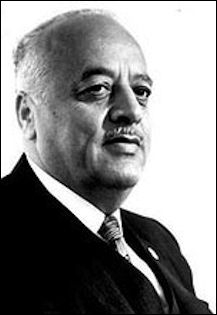
Ahmad Shuqeiri, a Lebanon-born politician of mixed Egyptian, Hijazi, and Turkish descent, became the founding chairman of the Palestine Liberation Organization. But in May 1956, he told the U.N. Security Council, "Palestine is part and parcel in the Arab homeland," adding that Palestine "is nothing but southern Syria."

Another prominent adherent to the pan-Arab ideal was Ahmad Shuqeiri, a Lebanon-born politician of mixed Egyptian, Hijazi, and Turkish descent, who served as the Arab League's deputy secretary-general and as the Syrian and Saudi delegate to the U.N. before becoming, on May 28, 1964, the founding chairman of the Palestine Liberation Organization (PLO), established that day by the Arab states at the initiative of Egyptian president Gamal Abdel Nasser.

"Palestine is part and parcel in the Arab home-land," Shuqeiri told the U.N. Security Council on May 31, 1956: "The Arab world is not prepared to surrender one single atom of their right to this sacred territory." Clarifying to which part of the "Arab homeland" this specific territory belonged, he added that Palestine "is nothing but southern Syria." In his account, "the Palestine area was linked to Syria from time immemorial" and "there was no question of separation" until the great powers brought this about by creating mandates under the League of Nations, with Britain controlling Palestine and France administering Syria.[8]

Against this backdrop, it is hardly surprising that the PLO's hallowed founding document, the Palestinian Charter, adopted upon its formation and revised four years later to reflect the organization's growing militancy, has little to say about the Palestinians themselves. Devoting about two-thirds of its thirty-three articles to the need to destroy Israel, it defines the Palestinians as "an integral part of the Arab nation" rather than a distinct nationality and vows allegiance to the ideal of pan-Arab unity—that is to Palestine's eventual assimilation into "the greater Arab homeland"—while seeking to harness this ideal to its short-term ends:
The destiny of the Arab Nation and, indeed, Arab existence itself depend upon the destiny of the Palestinian cause. From this inter-dependence springs the Arab nation's pursuit of, and striving for, the liberation of Palestine. … Arab unity and the liberation of Palestine are two complementary objectives, the attainment of either of which facilitates the attainment of the other. Thus, Arab unity leads to the liberation of Palestine, the liberation of Palestine leads to Arab unity; and work toward the realization of one objective proceeds side by side with work toward the realization of the other.[9]

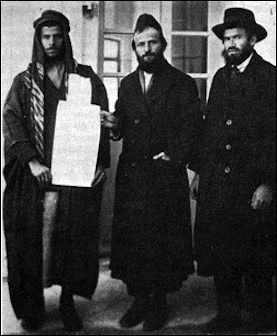
Jewish rabbis purchasing land from an Arab landowner (left), 1920s. In Mandate Palestine, ordinary Arabs were persecuted and murdered by their alleged betters for the crime of "selling Palestine" to the Jews. Meanwhile, these same betters were enriching themselves with impunity. Many prominent leaders made a handsome profit by selling land to Jews.
Even the November 1988 "declaration of independence" by the Palestine National Council, the PLO's "parliament," while obviously endorsing the idea of Palestinian statehood (in language that massively plagiarized Israel's proclamation of independence),[10] vows allegiance to the pan-Arab ideal by describing the "State of Palestine" as "an integral part of the Arab nation, of its heritage and civilization and of its present endeavor for the achievement of the goals of liberation, development, democracy and unity."[11]
As late as 2002, eight years after the establishment of a PLO-dominated Palestinian Authority (PA) in the West Bank and the Gaza Strip to lay the groundwork for Palestinian statehood in these territories, the prominent Israeli Arab politician Azmi Bishara, founding leader of the nationalist Balad Party (with seats in the Israeli parliament since 1999), asserted that "my Palestinian identity never precedes my Arab identity.… I don't think there is a Palestinian nation, there is [only] an Arab nation.… Palestine until the end of the nineteenth century was the southern part of Greater Syria," and the idea of a distinct Palestinian nation is a "colonialist invention" that happens to coincide with the consistent Israeli attempt, by both left- and rightwing parties, to ignore the reality of pan-Arab nationalism.[12]

While such plain speaking is hardly commonplace in PLO/PA current rhetoric, these words help explain the group's continued subscription to the pan-Arab ideal as evidenced by its deliberate failure to revise the Palestinian Charter so as to acknowledge the distinctness of Palestinian nationalism; the frequent articulation of pan-Arab themes by its tightly controlled media; its constitutional definition of the prospective state of Palestine as "part of the Arab homeland" committed to the "goal of Arab unity";[13] and the steady reiteration of the claim that the Palestinians are not fighting for their own corner but are rather the Arab nation's "front line of defense."[14] No less important, the PLO continues to subordinate its policies, and by extension Palestinian self-interest, to pan-Arab approval—and veto—as illustrated most recently by Abbas's successful rallying of the Arab League behind his "absolute and decisive rejection to recognizing Israel as a Jewish state."[15]

Upholding this position—sixty-six years after the creation of a Jewish state by an internationally recognized act of self-determination—effectively amounts to the rejection of Palestinian statehood for the simple reason that Israel would not self-destruct while the Palestinians and the Arab states are in no position to bring this about.

Islamist Imperial Dreams

If subscription to the pan-Arab dream has made the Palestinian cause captive to inter-Arab machinations, stirring unrealistic hopes and expectations in Palestinian political circles and, at key junctures, inciting widespread and horrifically destructive violence that has made the likelihood of Palestinian statehood ever more remote, adherence to Islamist ideals has subordinated Palestinian identity to the far wider ambition of Islamic world domination.

Consider the Islamic Resistance Movement, better known by its Arabic acronym Hamas. Since making its debut in the 1987-92 intifada, Hamas has established itself as the foremost political and military Palestinian force, winning a landslide victory in the 2006 general elections and evicting the PLO from Gaza the following year. Far from being an ordinary liberation movement in search of national self-determination, Hamas has subordinated its aim of bringing about the destruction of Israel and the creation of a Palestinian state on its ruins to the wider goal of establishing Allah's universal empire. In doing so, it has followed in the footsteps of its Egyptian parent organization, the Muslim Brotherhood, which viewed its violent opposition to Zionism from the 1930s and 1940s as an integral part of the Manichean struggle for the creation of a worldwide caliphate rather than as a defense of the Palestinian Arabs' national rights. In the words of the senior Hamas leader Mahmud Zahar, "Islamic and traditional views reject the notion of establishing an independent Palestinian state … In the past, there was no independent Palestinian state. … [Hence] our main goal is to establish a great Islamic state, be it pan-Arabic or pan-Islamic."[16] He further explained: "Our position stems from our religious convictions … This is a holy land. It is not the property of the Palestinians or the Arabs. This land is the property of all Muslims in all parts of the world."[17]

Echoing standard Muslim Brotherhood precepts, Hamas's covenant adopted in 1988 presents the organization as designed not merely to "liberate Palestine from Zionist occupation" but to pursue the far loftier goals of spreading Islam's holy message and defending the weak and oppressed throughout the world: "As the Islamic Resistance Movement paves its way, it will back the oppressed and support the wronged [throughout the world] in all its might. It will spare no effort to bring about justice and defeat injustice, in word and deed, in this place and everywhere it can reach and have influence therein."[18] As the movement's slogan puts it: "Allah is [Hamas's] target, the Prophet is its model, the Koran its constitution: Jihad is its path, and death for the sake of Allah is the loftiest of its wishes."[19]

Palestinian Hamas leader Mahmoud Zahar walks on an Israeli flag during a rally to mark the anniversary of the group's founding, Gaza City, December 9, 2010. Despite its anti-Israel rhetoric, Hamas has subordinated its aim of destroying the Jewish state and creating a Palestinian state to the wider goal of establishing a universal Islamic empire. Zahar explained: "Islamic and traditional views reject the notion of establishing an independent Palestinian state … [Hence] our main goal is to establish a great Islamic state."
In other words, the "question of Palestine" is neither an ordinary territorial dispute between two national movements nor a struggle by an indigenous population against a foreign occupier. It is an integral part of Islam's millenarian jihad to expand its domain and prevent the fall of any of its parts to the infidels: "[T]he land of Palestine is an Islamic Waqf [Islamic religious endowment] consecrated for future Moslem generations until Judgment Day. … The day that enemies usurp part of Moslem land, Jihad becomes the individual duty of every Moslem."[20]

In this respect, there is no difference between Palestine and other parts of the world conquered by the forces of Islam throughout history. To this very day, for example, Arabs and many Muslims unabashedly pine for the restoration of Muslim Spain and look upon their expulsion from that country in 1492 as a grave historical injustice. Indeed, even countries that have never been under Islamic imperial rule have become legitimate targets of Islamist fervor. Since the late 1980s, various Islamist movements have looked upon the growing number of French Muslims as a sign that France, too, has become a potential part of the House of Islam. Their British counterparts have followed suit. "We will remodel this country in an Islamic image," the London-based preacher Sheikh Omar Bakri Muhammad told an attentive audience less than two months after 9/11. "We will replace the Bible with the Qur'an."[21]

Khaled Mash'al, head of Hamas's political bureau and the organization's effective leader, echoed this sentiment as a tidal wave of Muslim violence swept across the world in response to satirical depictions of the prophet Muhammad in a Danish newspaper in February 2006:
By Allah, you will be defeated ... Hurry up and apologize to our nation, because if you do not, you will regret it. This is because our nation is progressing and is victorious ... Tomorrow, our nation will sit on the throne of the world. This is not a figment of the imagination but a fact. Tomorrow we will lead the world, Allah willing. Apologize today, before remorse will do you no good.[22]
Nor is this supremacist worldview limited to Hamas. Since its rise in the early seventh century, Islam has constituted the linchpin of Middle Eastern politics, and its hold on Palestinian society is far stronger than is commonly recognized. Contrary to the received wisdom in the West, the PLO is hardly a secular organization. Arafat was a devout Muslim, associated in his early days with the Muslim Brotherhood, as were other founding fathers of Fatah, the PLO's foremost constituent organization. And while the new generation of Fatah leaders in the territories may be less religious, they, nevertheless, have a draft constitution for a prospective Palestinian state stipulating that "Islam is the official religion in Palestine" and Shari'a is "a main source for legislation."[23]

They have, moreover, utilized the immense inflammatory potential of Islam to discredit the two-state solution—and by implication, the prospect of Palestinian statehood—and to express their grandiose supremacist delusions. In the words of the official PA television, "Where did Great Britain disappear? By Allah's will, He will get rid of the US like he got rid of them. We [Muslims] have ruled the world; a day will come by Allah, and we shall rule the world [again]. The day will come, and we shall rule America; the day will come, and we shall rule Britain. We shall rule the entire world."[24]
Within these grand overlapping schemes of pan-Arab regional unity and Islamic world domination, the notion of Palestinian statehood is but a single transient element whose supposed centrality looms far greater in Western than in Islamic and Arab eyes.

Profits of Misery

But whatever their ideological and political convictions, Palestinian leaders have never had a real stake in statehood both because the hopes and wishes of their constituents did not figure in their calculations and because they have vastly profited from having their hapless constituents run around in circles for nearly a century while milking world sympathy for the plight they have brought about in the first place.

In Mandate Palestine, ordinary Arabs were persecuted and murdered by their alleged betters for the crime of "selling Palestine" to the Jews. Meanwhile, these same betters were enriching themselves with impunity. The staunch pan-Arabist Awni Abdel Hadi, who vowed to fight "until Palestine is either placed under a free Arab government or becomes a graveyard for all the Jews in the country,"[25] facilitated the transfer of 7,500 acres to the Zionist movement, and some of his relatives, all respected political and religious figures, went a step further by selling actual plots of land. Many prominent leaders including Muin Madi, Alfred Rock, and As'ad Shuqeiri (father of Ahmad, PLO founder) also sold land. Musa Alami, who bragged to David Ben-Gurion that "he would prefer the land to remain poor and desolate even for another hundred years" if the alternative was its rapid development in collaboration with the Zionists,[26] made a handsome profit by selling 225 acres to the Jews. So, too, did numerous members of the Husseini family, the foremost Palestinian Arab clan during the mandate period, including Musa Kazim (father of Abdel Qader Husseini, the famous guerrilla leader) and Muhammad Tahir, Hajj Amin's father.[27]

Hajj Amin himself had few qualms about profiting from the Jewish national revival, which he sought to eradicate whenever this suited his needs. Prior to his appointment as the Jerusalem mufti, he pleaded with Jewish leaders to lobby on his behalf with (the Jewish) Herbert Samuel, the first British high commissioner for Palestine, and in 1927, he asked Gad Frumkin, the only Jewish Supreme Court justice during the mandatory era, to influence Jerusalem's Jewish community to back the Husseini candidate in the mayoral elections. He likewise employed a Jewish architect to build a luxury hotel for the Supreme Muslim Council, which he headed, while ordering his constituents to boycott Jewish labor and products.[28] Needless to say, the mufti never sought to apply to his own father his religious authorization (fatwa) on the killing of those who sold land to Jews.
"Arab nationalist feelings were never allowed to harm the interests of the Husseini family," wrote the prominent Jerusalem lawyer and Zionist activist Bernard (Dov) Joseph, a future minister of justice in the Israeli government:
One of [the mufti's] kinsmen, Jamil Husseini, had once engaged my services in land litigation which went as high as the Privy Council in London … For years, one of the Mufti's close relations prospered mightily by forcing Arab small-holders to sell land, at niggardly prices, which he then resold to Jews at a handsome profit.[29]
This institutionalized racketeering skyrocketed to new heights under the PLO. Just as the Palestinian leadership during the mandate had no qualms about inciting its constituents against Zionism and Jews while lining its own pockets from the fruits of Jewish development and land purchases, so the cynical and self-seeking PLO "revolutionaries" used the billions of dollars donated by the Arab oil states and the international community to lead a luxurious lifestyle in sumptuous hotels and villas, globe-trotting in grand style, acquiring properties, and making financial investments worldwide—while millions of ordinary Palestinians scrambled for a livelihood.
This process reached its peak following the September 1993 signing of the Israel-PLO Declaration of Principles on Interim Self-government Arrangements (DOP, or Oslo I) and the establishment of the Palestinian Authority. For all his rhetoric about Palestinian independence, Arafat had never been as interested in the attainment of statehood as in the violence attending its pursuit. In the late 1970s, he told his close friend and collaborator, the Romanian dictator Nicolae Ceausescu, that the Palestinians lacked the tradition, unity, and discipline to become a formal state, and that a Palestinian state would be a failure from the first day.[30] Once given control of the Palestinian population in the West Bank and Gaza as part of the Oslo process, he made this bleak prognosis a self-fulfilling prophecy, establishing a repressive and corrupt regime in the worst tradition of Arab dictatorships where the rule of the gun prevailed over the rule of law and where large sums of money donated by the international community for the benefit of the civilian Palestinian population were diverted to funding racist incitement, buying weaponry, and filling secret bank accounts. Extensive protection and racketeering networks run by PA officials proliferated while the national budget was plundered at will by PLO veterans and Arafat cronies (in May 1997, for example, the first-ever report by the PA's comptroller stated that $325 million, out of the 1996 budget of $800 million had been "wasted" by Palestinian ministers and agencies or embezzled by officials).[31]

Arafat himself held a secret Tel Aviv bank account accessible only to him and his personal advisor Muhammad Rashid, in which he insisted that Israel deposit the tax receipts collected on imports to the Palestinian territories (rather than transfer them directly to the PA). In 1994-2000, nearly eleven billion shekels (about US$2.5 billion) were reportedly paid into this account, of which only a small, unspecified part reached its designated audience.[32] Small wonder that, in 2004, the French authorities opened a money-laundering inquiry into suspect regular transfers into the Paris bank accounts held by Arafat's wife Suha, who resided there with their daughter. After Arafat's death, Suha was reportedly promised an annual pension of $22 million to cover her sumptuous lifestyle, paid from an alleged $4 billion "secret fortune" managed personally by the PA president and kept in a number of bank accounts in Tel Aviv, London, and Zurich.[33]

Though this breathtaking corruption played an important role in Hamas's landslide electoral victory of January 2006, the PLO/PA leadership seems to have learned nothing and to have forgotten nothing. Not only did Abbas, who succeeded Arafat as PLO chairman and PA president, blatantly ignore the results of the only (semi) democratic elections in Palestinian history—establishing an alternative government to the legally appointed Hamas government and refusing to hold new elections upon the expiry of his presidency in January 2009—but he seems to have followed in his predecessor's kleptocratic footsteps, reportedly siphoning at least $100 million to private accounts abroad and enriching his sons at the PA's expense.[34] In the words of Fahmi Shabaneh, former head of the Anti-Corruption Department in the PA's General Intelligence Service:
In his pre-election platform, President Abbas promised to end financial corruption and implement major reforms, but he hasn't done much since then. Unfortunately, Abbas has surrounded himself with many of the thieves and officials who were involved in theft of public funds and who became icons of financial corruption. … Some of the most senior Palestinian officials didn't have even $3,000 in their pocket when they arrived [after the signing of the Oslo accords]. Yet we discovered that some of them had tens, if not hundreds, of millions of dollars in their bank accounts. … Had it not been for the presence of the Israeli authorities in the West Bank, Hamas would have done [there] what they did in the Gaza Strip. It's hard to find people in the West Bank who support the Palestinian Authority. People are fed up with the financial corruption and mismanagement of the Palestinian Authority.[35]

Conclusion

For nearly a century, Palestinian leaders have missed no opportunity to impede the development of Palestinian civil society and the attainment of Palestinian statehood. Had Hajj Amin Husseini chosen to lead his constituents to peace and reconciliation with their Jewish neighbors, the Palestinians would have had their independent state over a substantial part of mandate Palestine by 1948, if not a decade earlier, and would have been spared the traumatic experience of dispersal and exile. Had Arafat set the PLO from the start on the path to peace and reconciliation instead of turning it into one of the most murderous and corrupt terrorist organizations in modern times, a Palestinian state could have been established in the late 1960s or the early 1970s; in 1979, as a corollary to the Egyptian-Israeli peace treaty; by May 1999, as part of the Oslo process; or at the very latest, with the Camp David summit of July 2000. Had Abbas abandoned his predecessors' rejectionist path, a Palestinian state could have been established after the Annapolis summit of November 2007, or during President Obama's first term after Benjamin Netanyahu broke with the longstanding Likud precept by publicly accepting in June 2009 the two-state solution and agreeing to the establishment of a Palestinian state.

But then, the attainment of statehood would have shattered Palestinian leaders' pan-Arab and Islamist delusions, not to mention the kleptocratic paradise established on the backs of their long suffering subjects. It would have transformed the Palestinians in one fell swoop from the world's ultimate victim into an ordinary (and most likely failing) nation-state thus terminating decades of unprecedented international indulgence. It would have also driven the final nail in the PLO's false pretense to be "the sole representative of the Palestinian people" (already dealt a devastating blow by Hamas's 2006 electoral rout) and would have forced any governing authority to abide, for the first time in Palestinian history, by the principles of accountability and transparency. Small wonder, therefore, that whenever confronted with an international or Israeli offer of statehood, Palestinian leaders would never take "yes" for an answer.
Efraim Karsh, editor of the Middle East Quarterly, is professor of Middle East and Mediterranean studies at King's College London and professor of political studies at Bar-Ilan University where he is also a senior research associate at the BESA Center for Strategic Studies. This article is part of a wider study prepared under the auspices of the BESA Center.

[1] Daniel Pipes, "Palestine for the Syrians?Commentary, Dec. 1986.
[2] Jamal Husseini, "Report of the State of Palestine during the Four Years of Civil Administration, Submitted to the Mandate's Commission of the League of Nations through H.E. the High Commissioner for Palestine, by the Executive Committee of the Palestine Arab Congress—Extract," Oct. 6, 1924, Central Zionist Archive (CZA, Jerusalem), S25/10690, p. 1.
[3] "Minutes of the Ninth Session, Held at Geneva from June 8th to 25th, 1926, including the Report of the Commission to the Council," 22nd meeting, Permanent Mandates Commission, League of Nations, June 22, 1926.
[4] "The Arabs Reject Partition," quoted from Palestine & Transjordan, July 17, 1937, p. 1, CZA; "Minutes of the JAE Meeting on Apr. 19, 1937," Ben-Gurion Archive (Sde Boker).
[5] The New York Times, Aug. 25, 1947.
[6] The Ambassador in Turkey to the Foreign Ministry (Enclosure), July 6, 1940, Documents on German Foreign Policy 1918-1945 (London: HMSO, 1949), ser. D, vol. 10, pp. 143-4; The Grand Mufti to Adolf Hitler, Jan. 20, 1941, ibid., ser. D, vol. 11, pp. 1151-5; Record of the Conversation between the FĂĽhrer and the Grand Mufti of Jerusalem on Nov. 28, 1941, in the Presence of Reich Foreign Minister and Minister Grobba in Berlin, Nov. 30, 1941, ibid., pp. 881-5.
[7] Ghada Hashem Talhami, Syria and the Palestinians: The Clash of Nationalisms (Gainesville: University Press of Florida, 2001), pp. 49-50.
[8] "Excerpts from Statements in the U.N. on Mideast," The New York Times, June 1, 1956; "Syria Says in U.N. Palestine Is Hers," ibid.
[9] The Palestinian National Charter, Resolutions of the Palestine National Council, July 1-17, 1968, art. 13-14; see, also, art. 11, 12, 15.
[10] Daniel Pipes, "Declaring Independence: Israel and the PLO,Orbis, Mar. 1989, pp. 247-60.
[11] "Declaration of Independence (1988)," website of the "State of Palestine."
[12] Ari Shavit, "Ha'ezrah Azmi,Haaretz (Tel Aviv), Nov. 25, 2002; Bishara on Israeli Channel 2 TV, n.d., YouTube.
[13] 2003 Permanent Constitution Draft, Palestinian Basic Law, chap. 1, art. 2, May 4, 2003.
[14] See, for example, statements by Fatah's official spokesman Ahmad Assaf on official PA TV and Egyptian TV, Mar. 19, 2014, "Fatah Spokesman: Israel's goal is to rule 'from the Euphrates to the Nile,'" Palestinian Media Watch (Jerusalem), Mar. 23, 2014.
[15] HaaretzMar. 26, 2014.
[16] "Exclusive Interview with Hamas Leader," The Media Line, Sept. 22, 2005; Walid Mahmoud Abdelnasser, The Islamic Movement in Egypt: Perceptions of International Relations, 1967-81(London: Kegan Paul, 1994), p. 39.
[17] Zahar's interview with Asharq al-Awsat (London), Aug. 18, 2005, in Special Dispatch, no. 964, Middle East Media Research Institute (MEMRI, Washington, D.C.), Aug. 19, 2005.
[18] "Hamas Covenant," Yale Law School, Avalon Project, art. 10.
[19] Ibid., art. 8.
[20] Ibid., art. 11, 15.
[21] Gilles Kepel, Jihad: The Trail of Political Islam (Cambridge: Harvard University Press, 2002), p. 306; Michel Gurfinkiel, "Islam in France: The-French Way of Life Is in Danger,"Middle East Quarterly, Mar. 1997; The Observer (London), Nov. 4, 2001; Anthony Browne, "The Triumph of the East," The Spectator (London), July 24, 2004.
[22] Mash'al's address, al-Murabit Mosque, Damascus, aired on Aljazeera TV (Doha), Feb. 3, 2006, in "Special Dispatch No. 1087," MEMRI, Feb. 7, 2006.
[24] Palestinian Authority TV, May 13, 2005, Palestinian Media Watch.
[25] "Conversation with Awni Abdel Hadi," June 3, 1920, Hagana Archive (Tel Aviv), 80/145/11.
[26] David Ben-Gurion, My Talks with Arab Leaders (Jerusalem: Keter, 1972), pp. 15-6.
[27] Kenneth W. Stein, The Land Question in Palestine, 1917-1939 (Chapel Hill: University of North Carolina Press, 1984), pp. 182, 228-39.
[28] Gad Frumkin, Derekh Shofet Beyerushalaim (Tel Aviv: Dvir, 1956), pp. 216, 280-90; Eliahu Elath, Shivat Zion Vearav (Tel Aviv: Dvir, 1974), p. 245; Yehuda Taggar, The Mufti of Jerusalem and Palestine: Arab Politics, 1930-1937 (New York and London: Garland, 1986), p. 83.
[29] Dov Joseph, The Faithful City: The Siege of Jerusalem, 1948 (New York: Simon and Schuster, 1960), p. 194.
[30] Ion Pacepa, Red Horizons. Inside the Romanian Secret Service—The Memoirs of Ceausescu's Spy Chief (London: Coronet Books, 1989), p. 28.
[31] Agence France-Presse, May 24, July 30, 1997; Khaled Abu Toameh, "Money down the Drain?" Jerusalem Report, Jan. 8, 1998, p. 26; Ronen Bergman, Veharashut Netuna (Tel Aviv: Yediot Ahronot, 2002), p. 156.
[32] Ehud Ya'ari, "The Independent State of Arafat," Jerusalem Report, Sept. 5, 1996, pp. 22-3; Bergman, Veharashut Netuna, pp. 113-41; Rachel Ehrenfeld, "Where Does the Money Go? A Study of the Palestinian Authority," American Center for Democracy, New York, Oct.1, 2002, pp. 7-10; Said Aburish, Arafat: From Defender to Dictator (London: Bloomsbury, 1998), p. 306.
[33] Ynet (Tel Aviv), Aug. 16, 2006Sydney (Aus.) Morning HeraldFeb. 13, 2004.
[34] Jonathan Schanzer, "Chronic Kleptocracy: Corruption within the Palestinian Political Establishment," Hearing before U.S. House Committee on Foreign Affairs Subcommittee on the Middle East and South Asia, Washington, D.C., July 10, 2012, pp. 17-8; Bergman, Veharashut Netuna, pp. 162-3; Ehrenfeld, "Where Does the Money Go?" pp. 9-10; Yediot Ahronot (Tel Aviv), July 14, 2002.
[35] The Jerusalem PostJan. 29, 2010.

http://www.meforum.org/3831/palestinians-reject-statehood#.U5Li0LHQvi1.facebook

Monday, June 2, 2014

Finally Awake: From Pro Palestinian Activist To Staunch Israel Supporter

Finally Awake: From Pro Palestinian Activist To Staunch Israel Supporter

Linda and The Fink

As a new contributor to Israellycool, let me begin by introducing myself.

I am a Canadian, a mom and a seeker of truth. For many years, I was a “pro-Palestinian peace activist”. Eventually I began to see that “peace” did not mean what I thought it meant.

However, during that time, I came to believe certain things about the Arab/Israeli conflict.

I had come to believe that Israel was always guilty and Palestinians were always innocent victims.

In 2009, I had an opportunity to go to Gaza for 3 weeks. I returned in 2010 and intended to stay for the school year, but my plans changed.

As the time passed while I was in Gaza, I began to see inconsistencies between what I had been told about Gaza and what I was seeing and living. But I had more pressing concerns. Like learning that my spouse and his family had no intentions of letting me return to my family in Canada.

I worked at the American International School in Gaza. The administrators there really tried to watch for any anti-Israel attitudes and would address such immediately.

One time, I reported an essay that one of my students wrote, which was full of images of bombings and the murder of Jews. I was alarmed and when I presented it to the administrators, they assured me they would deal with this student, even expelling him if he continued writing essays of this nature.
My spouse did not “allow” me to visit my coworkers who had become my friends.

My salvation came in the form of encephalitis, a serious brain infection, that left me in a coma, barely alive and not expected to survive, but which also put me in an ambulance on my way to Tel Aviv.
Once there, I finally got to meet people about whom I had heard so many horror stories. The doctor who brainstormed with his team to figure out how to save my life, the nurses who kept encouraging me to keep trying even though my body no longer worked, the physiotherapist who didn’t let me give up – these people didn’t match the descriptions of Israelis I had been given for so many years.

My time in the hospital impacted me deeply, but when I returned to Canada, my spouse was able to come with me. I had suffered a significant brain injury from the prolonged fever so I was very dependent for a long time. During this time, his abuse became much more frequent. In my condition, I was unable to do more than simply try to get through each day. I found myself trying to make him happy so he would treat me well.

I tried. Things kept getting worse.

We had arrived in Canada in December 2010. It took approximately 2 years for my brain to recover and for me to feel strong again. By this time, I was fed up with his abuse but also felt guilty that I wanted to kick him out. I was fed up with him blaming Israel for his abusive behavior.

It was during this time that I really saw how ridiculous it all was. We often talked about politics. While in Gaza, I had talked about politics with so many. Even the children there talk about politics!

Whenever I would speak up and disagree, he would rage at me, accusing me of standing with “the Jews” and against the Palestinians (There was always an expletive between “the” and “Jews” but I will spare you that).

I also noticed that although he supported Fatah back in Gaza, once he was here, all of his friends were Hamas supporters.

We finally split up in 2013. I spent several weeks just trying to regain my peace of mind and found memories that I didn’t realize I had flooding back.

I was shaken to realize his true views on Israel and Jewish people and relieved to find how far apart our views had become.

Over the next several months, I worked on learning more about what Israelis said about the situation. Again, I was learning things that were quite different than some of the things I had been told before and, more importantly, I began to understand another perspective.

Finally, this past February, I made my first visit to Israel since my hospitalization. I stayed with friends who I had gotten to know during my quest to understand.

While in Israel, I made a point of observing as many aspects of life as I could. With so much talk of “apartheid”, I purposely looked for signs of this, and instead, noticed how casually people mixed together as they went about their daily lives.

My friends showed me their Israel – no hype, no propaganda, just real life.

I will never be the same.

Now I have to speak truth against the lies I know are being told. I have seen two sides, Gaza and Israel, and have no choice but to share my stories and observations in the hopes of waking others up who have believed the lies just as I did.

I am so happy and grateful to finally be awake!

http://www.israellycool.com/2014/06/01/finally-awake-from-pro-palestinian-activist-to-staunch-israel-supporter/

Sunday, June 1, 2014

Op-Ed: Breakthrough or Another Lost Palestinian Opportunity?

Op-Ed: Breakthrough or Another Lost Palestinian Opportunity?

Will this be another case of the Palestinian Arabs never missing an opportunity to miss an opportunity?


David Singer


The publication of  "A  Palestinian State - Not A Priority"  in the Palestine Telegraph on May 23 offers the tantalizing prospect of a possible breakthrough in resolving the Arab-Jewish conflict.

Three reasons support such optimism:

Firstly - the Palestine Telegraph is published in Gaza - its  web site declaring:

"The PT is a non-profit project that depends totally on donations from people of good will committed to freedom of speech for all people. Our success will come from the commitment of our volunteer reporters and the interest of people of good will seeking true change in our world; one where all people are respected and indeed have equal human rights...

"...The Palestine Telegraph/PT is the first Electronic Newspaper based in the Gaza Strip, Palestine, staffed by Palestinians and international volunteers; professional journalists and members of the New Fourth Estate – citizen journalists who do not take assignments from editors or paychecks from corporate controlled media."

Secondly - the article's editor - Yoram Ettinger - is a distinguished Israeli whose CV includes:

"(Since 1993) Consultant to Israel’s Cabinet Members, to Israeli legislators and to the Knesset Foreign Affairs and Defense Committee on US-Israel bilateral projects, US policy and Mideast politics.

"Executive Director of "Second Thought – A U.S. Israel Initiative," dedicated to generate out-of-the-box thinking on US-Israel relations, Middle East politics, the Palestinian issue, Jewish-Arab demographics, Jerusalem, Judea and Samaria."

Thirdly - Ettinger's article contains the following powerful message for Gaza's readers to digest - indeed for all who seek to end this conflict that has raged unresolved for the last 130 years.


Palestine has been a geographic, not a national, concept, as evidenced by the lack of distinct, cohesive national character of its Arab inhabitants.
"The Palestinian issue has benefited from the Arab/Muslim talk, but — due to the Palestinian record of intra-Arab subversion — has never been supported by the Arab/Muslim walk. Arab/Muslim policy makers have never considered the Palestinian issue a strategic interest, but rather a tactical instrument to advance intra-Arab or Muslim interests and to annihilate the Jewish state.

"Irrespective of this, Palestine has been a geographic, not a national, concept, as evidenced by the lack of distinct, cohesive national character of its Arab inhabitants. This lack of cohesion has been intensified by the violent internal fragmentation along various lines: cultural (such as Bedouin vs. rural vs. urban sectors), geographic (e.g. mountain vs. coastal Arabs, southern vs. northern, Hebron vs. Bethlehem, Nablus vs. Ramallah, Nablus vs. Hebron), ethnic, ideological, political (pro- or anti-Jordan), historical and tribal identity. Such turbulent fragmentation was fueled by the multitude of Arab or Muslim migration waves from Bosnia, Algeria, Libya, Egypt, Jordan, the Arabian Peninsula, Syria and Lebanon.

"The establishment of a Palestinian state was not on the agenda of the non-Arab Muslim Ottoman Empire, which ruled the area from 1517 through 1917. The Ottomans linked the area, defined by most Arabs as a region within Southern Syria or the Levant, to the Damascus and Beirut provinces.

"The British Empire, which dominated the Middle East from 1917 until the end of World War II, did not contemplate a Palestinian Arab state, while establishing a series of Arab countries throughout the Middle East. Moreover, the 1917 Balfour Declaration dedicated Palestine, including Jordan, to the Jewish homeland.

"The 1920 San Remo Resolution, formulated by the principal Allied Powers, formalized the Balfour Declaration-based British Mandate for Palestine, which was ratified on Aug. 12, 1922, by the League of Nations, eventually transferring 77 percent of Palestine (Jordan) to the Arabs. The U.S. House and Senate approved it unanimously on June 30, 1922. In 1945, the Mandate for Palestine was integrated into the U.N. Charter via Article 80, which precludes alterations, and is still legally binding.

"Jordan and Egypt occupied Judea and Samaria and Gaza from 1949 through 1967, but did not ponder the establishment of a Palestinian state; nor did the Arab League.

"According to Dr. Yuval Arnon-Ohanna of Ariel University, who headed the Palestinian Desk at the Mossad Research Division, the secretary-general of the Arab League, Azzam Pasha, stated in September 1947 that the core problem was not a Palestinian state or Jewish expansionism. The only priority was the duty to uproot the Jewish presence from Palestine, which was defined by Muslims as 'Waqf' — an area divinely endowed to Islam and not to the 'infidel.'"

Such an article appearing in a Gaza Electronic Newspaper written by so eminent an Israeli with such close links to the Israeli Government would have been unthinkable just one month ago.

Did the publication of this article somehow accidentally slip through the Hamas Government censor's scrutiny or does it signify the willingness of Hamas to engage in negotiations whose agenda for the first time would be based on the facts presented so succinctly by Ettinger?

Until now the PLO has dismissed the 1917 Balfour Declaration, the 1922 Mandate for Palestine and everything that has happened since then as being null and void.

However three weeks ago Hamas leader Ismail Haniyeh told MIddle East Monitor:

"Both nations, Jordan and Palestine, share the same history and present,"

Jordan and Palestine's joint modern history commenced with the Balfour Declaration and Mandate for Palestine - and subsequently unfolded as accurately recounted in Ettinger's article.

As negotiations to effect a reconciliation between Hamas and the PLO  reportedly gain momentum -  the beginnings of a commonly-agreed Jewish and Arab narrative based on fact - not fiction - could hopefully become the basis for resuming future negotiations,

Imminent breakthrough or yet another lost opportunity?

http://www.israelnationalnews.com/Articles/Article.aspx/15087#.U4st1q2SxQo

Paying Palestinians to Leave a 'Positive Solution'


Expert: Paying Palestinians to Leave a 'Positive Solution'

Dr. Martin Sherman of the Israeli Institute for Strategic Studies says that UNWRA funds be used to pay Arabs to resettle elsewhere

By Yaakov Levi


At an event in Haifa last week, Dr. Martin Sherman, head of the Israeli Institute for Strategic Studies, said that the best way to ensure the future of a Jewish Israel, and the individual welfare of Arabs living in Judea and Samaria, was to offer an “evacuation-compensation” package for them, similar to the process undertaken by the government for families who live in buildings slated for urban renewal projects.

Sherman was speaking at a conference on sovereignty for Judea and Samaria sponsored by Women in Green and the Hazon Leumi (National Vision) students' organization. In the past, Sherman said, efforts to establish multiple sovereignties on the land between the Mediterranean Sea and the Jordan River had fallen flat, and the current “experiment,” in which the Palestinian Authority was given limited sovereignty over parts of Judea, Samaria, and Gaza, only proved the point. Eventually, he said, there would be only one sovereign – Israel, the Jewish state, or an Arab Muslim entity.

On that basis, Sherman said, it was legitimate for Israel, which is fighting for the survival of its Jewish population, to offer Arabs a deal in which they would be compensated for leaving their homes and moving abroad. Israel would eventually be forced to adopt a policy like this, because of the demographic pressures it will be subject to from a large and restive Arab population in Judea and Samaria.

The solution to the overall problems of sovereignty and demography, said Sherman, was three-pronged: First, the United Nations organization responsible for dealing with the Palestinians – UNWRA – must be dismantled, or expelled from all areas of Judea, Samaria and Gaza. UNWRA, more than any other organization, is responsible for preserving the “refugee” status of Palestinians, decades after their grandparents and great-grandparents fled their homes in Israel, in order to move out of the way and allow seven Arab armies to destroy the newly-founded State of Israel in 1948. Without UNWRA support, he said, all but about 50,000 of the 5 million people around the world who claim to be Palestinian refugees will give up that status.

After that, said Sherman, the massive budget that had been provided to UNWRA should be transferred to a fund that will allow Palestinian ex-refugees to resettle in a new home of their choice. The fund should provide enough money to resettle families and clans, providing them with positive living, work, and educational opportunities in Arab or Western countries.

Once those arrangements are in place, he said, it will be possible to approach Arab families and clans with offers that will be worth their while. According to Sherman, an offer like this to the heads of extended families among Palestinians would be embraced.

This is not an “expulsion” or “transfer” plan, said Sherman, but a humanitarian one “that will provide benefits for the Arab population, as well as for the countries that agree to receive them as new, wealthy residents.”

Sherman's idea is similar to one proposed by MK Moshe Feiglin (Likud-Beiteinu) last year. Speaking at the 2013 Sovereignty Conference, Feiglin said that Israel should offer each Palestinian Authority Arab $500,000 to leave Israel. “The country pays 10% of its gross national product every year to maintain the ‘two-state solution’ and the Oslo Accords,” Feiglin said, including money for security fences and checkpoints, Iron Dome missile defense systems and guards whom he said are posted “at every cafĂ©.” Feiglin said the same money could be used to pay every PA Arab half a million dollars to leave Israel.


http://www.israelnationalnews.com/News/News.aspx/181253#.U4suTq2SxQo