Thursday, March 1, 2012

A Palestinian refugee story: myths vs. facts


A Palestinian refugee story: myths vs. facts


Linah Alsaafin is a young British-born Palestinian, who is blogging at various anti-Israeli sites, including Mondoweiss and the Electronic Intifada.
According to her biographical note on Mondoweiss, she “was born in Cardiff, Wales, and was raised in England, the United States, and Palestine.” This of course also means that she has British citizenship, and interestingly, this fact is acknowledged on one of the blogs she contributes to: “Life on Bir Zeit Campus” is described as “A Regular Ode to the Hardships and Joy of Living as expatriates of our Countries of Citizenship in the Holy Land…as Falastiniyyas!”
By coincidence, I came across a tweet of hers, where she announced the passing of her grandfather:
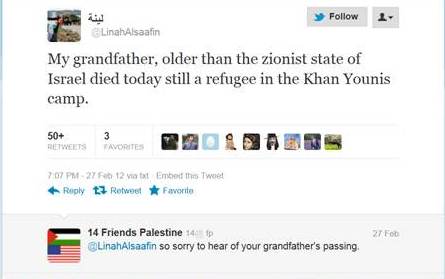
I thought that given the circumstances, it wouldn’t be appropriate to respond and point out that while it was certainly sad that her grandfather spent most of his life as a refugee in the Khan Younis camp in Gaza, this was actually a choice made by Palestinians and Arabs – after all, neither the Egyptians who ruled Gaza until 1967, nor the PA and Hamas that have control of Gaza since Israel’s withdrawal in 2005, have done anything to integrate the refugees.
However, since Linah Alsaafin has now published a related post that exploits her grandfather’s story for political purposes, I think there is no reason to be more respectful of the occasion than she herself is.
It is a long post that mixes very personal memories with political propaganda that is very typical for Palestinian myth-making activism.
To quote some of Alsaafin’s most misleading claims:
My grandfather, 84 year old Ibrahim Hasan Alsaafin, was older than the Zionist state of Israel when he died on Monday in the Khan Younis refugee camp, still yearning to return to his village of al-Fallujah 64 years on, a mere 15 miles away.
On my way to Hebron last Friday for the third annual global Open Shuhada Street protest, the taxi I was in passed by a sign pointing right with the black letters of “Qiryat Gat” emblazoned on it. My heart caught in my mouth, and I craned my neck to hold that sign in my vision long after the taxi turned left.
Qiryat Gat is the Judaized name for my village of al-Fallujah. My village became a Jewish-only settlement for Russian immigrants in the 1950s, and the site for one of Intel Corporation’s biggest manufacturing plants.
Al-Fallujah was completely ethnically cleansed on March 1st, 1949 — a year after Israel’s so-called independence. Sido Ibrahim was a young man then, 19 or 20 years old, and fought with Egyptian paratroops against the terrorist Zionist guerrillas, who attacked the village with jet fighters and long range canons for six months. Most of the villagers fled, taking with them only their children, some even leaving the doors of their houses open. Sido, along with my great-grandmother Nabeeha, joined the scores of villagers in providing food and supplies to the Egyptian and local volunteers who were defending the village. […]
After six months of shelling and raids, the international community decided that al-Fallujah must be evacuated and remain under international control. Sido and my great-grandmother Nabeeha exchanged hugs and tears with the Egyptian fighters who dropped them off along with other civilians in Gaza in their trucks before returning back to Egypt. Sido did not forget to bring the land deeds with him, which we still keep, and my great-grandmother took the key with her, which we also still keep.
First, it is noteworthy that a young man who moved just some 15 miles from one Arab-Muslim community to another Arab-Muslim community was classified as a “refugee” for the rest of his life. Moreover, Alsaafin’s grandfather was brought to Gaza by Egyptian troops, whose war against the fledgling Jewish state he had actively supported – and of course, Mr. Alsaafin would continue to live as a “refugee” under Egyptian rule for almost two decades.
A related correction is warranted in view of Linah Alsaafin’s claims about “Zionist” “jet fighters,” because in reality, the fledgling Israeli Air Force had a very hard time procuring suitable aircraft which were urgently needed to fight off the Egyptian bombing of Tel Aviv.
No less misleading and mistaken are Alsaafin’s remarks about what she calls “my village of al-Fallujah,” now known under its “Judaized name” Qiryat Gat.
As far as the fighting for Faluja is concerned, anyone interested in the facts can check out this timeline of Israel’s War of Independence (scroll down to the map for: Israel War of Independence October 1948 battles, entry for IDF operation Yoav, Oct. 15-22, Nov. 9, Dec. 28-29). The armistice agreement between Egypt and Israel of February 24, 1949, provided for the withdrawal of Egyptian forces from the Faluja pocket.
But Alsaafin’s most telling misrepresentation is perhaps her fact-free claim that “her” village “became a Jewish-only settlement for Russian immigrants in the 1950s.”
In reality – as Alsaafin could have easily found out just by consulting Wikipedia –Qiryat Gat (or Kiryat Gat) served for decades as a new home for the Jews that had to abandon their ancient communities in North Africa’s Arab countries due to the discrimination, dispossession and persecution they suffered as “retribution” for Israel’s establishment.
The town’s demography is reflected in Wikipedia’s list of Qiryat Gat’s “notable residents”: the far-left activist Tali Fahima (who has converted to Islam and fancies herself now a “Palestinian,” but comes from a Moroccan-Jewish family); the celebrated photographer Adi Ness (from an Iranian-Kurdish family); Likud politician and former IDF spokeswoman Miri Regev (from a Moroccan family); and singer and actress Ninet Tayeb (from a Tunisian family; her website is here).
Linah Alsaafin’s fact-free myth-making is quite typical for the propaganda provided by countless “pro-Palestinian” bloggers and activists. Unsurprisingly, she also blames Israel for the fact that for several years, she has not been able to visit her grandfather in Gaza. But while a negotiated peace agreement would obviously be the most straightforward solution to this problem, it seems that Alsaafin is adamantly opposed to negotiations. In one of her recent blog posts, she promotes protests and a twitter campaign devoted to saying #No2Negotiations; in another recent post, she rails against the “outdated so-called representatives [who] negotiate our rights away with the same side that is continuously oppressing us. It is simply ludicrous, shameful, and outright embarrassing that these negotiations still occupy a space in the Palestinian political spectrum. Only free men and women negotiate, and for all their money, expensive cars and villas, and security coordinated travel permits, the Palestinian leadership is still at the end of the day occupied by Israel and its caprices.”
Obviously, Linah Alsaafin can afford this kind of activism – she is, after all, a British expatriate who has chosen to study in the West Bank, but has always the option to return to the country she was born.
http://warped-mirror.com/2012/02/29/a-palestinian-refugee-story-myths-vs-facts/

Genocidal Liberalism: The University’s Jihad Against Israel & Jews


Genocidal Liberalism: The University’s Jihad Against Israel & Jews

By Jamie Glazov 
Editor’s note: The interview below is with Dr. Richard Cravatts, the author of Genocidal Liberalism: The University’s Jihad Against Israel & Jews, a new book published by the David Horowitz Freedom Center. To order a copy, click here.

Frontpage Interview’s guest today is Dr. Richard Cravatts, a Professor of Practice and Director of the Master’s Program in Communications Management at the Simmons College School of Management. He is President of Scholars for Peace in the Middle East, a grassroots community of over 50,000 academics on more than 3500 campuses worldwide, and a board member of the Journal for the Study of Antisemitism, the Investigative Taskforce on Campus Anti-Semitism, and the Louis D. Brandeis Center for Human Rights Under Law. He is also the author of the new book, Genocidal Liberalism: The University’s Jihad Against Israel & Jews (David Horowitz Freedom Center).


FP: Richard Cravatts, welcome to Frontpage Interview.
Illuminate for us the jihad against Jews and Israel on the American campus.
What is the extent to which the campus Left is allied with jihadist elements, Muslim student associations, and funded by Saudi money? Why do you think they have the formed this “unholy alliance”?


Cravatts: Many of us have been concerned for some time with the relentless, deceptive, and dangerous attacks against Israel emanating from college campuses, particularly because academia was always thought to be a place where honesty debate and scholarly inquiry could flourish. But at least with regard to Israel, that no longer is the case. In fact, what I characterize as an intellectual jihad against Israel is taking place right now on campuses everywhere, characterized by such vile  contortions of history and fact, and driven by such moral imbecility and double standards on the part of  its adherents, that is has few parallels as a campus movement.  It involves, first, a rapturous adherence to a cult of “Palestinianism,” in which seeking social justice for the ever-suffering Palestinians has become the primary intellectual mission of many liberals who deride Western values and democratic states, and a convenient cause for many in the Arab world for whom the Palestinians have become a club to use against Israel and Jews. On campuses, this has evolved into a dangerous “unholy alliance” between Islamists with a specific agenda to dilute Western institutions, and leftists who, in accommodating radical Islam, not only enable what Robert Spencer has called a “stealth jihad,” but help facilitate it.


On campuses, the stealth jihad is led by the Muslin Student Association, an off-shoot of the Muslim Brotherhood whose 600 chapters serve as command centers for inviting guest speakers with incendiary rhetoric, annual hate-fests during which Israel and Jews are libeled, slandered, and demonized, shouting down or preventing speeches by pro-Israel, anti-jihad speakers, and other instances extremist behavior and destructive narratives about the Israel/Palestinian debate. This alliance between jihadists and Leftists, who ordinarily share little in common, ideologically, serves both sides well: Muslim students who wish to deflect the pathologies of Palestinian cause savor being able to assign the West’s worst appellation of ‘racist’ to Israel, and campus liberals at the same time fulfill their Marxist dreams of trying to envision and help create what Ruth Wisse of Harvard called the “ideal of the egalitarian state,” something that the Left had hoped that Communism would create, but which ultimately failed to be established anywhere and in the pursuit of which some 100 million souls perished during the twentieth century.


And petro-dollars have helped to lubricate this stealth jihad. Jay P. Greene, a Senior Fellow at the Manhattan Institute , noted that “Gulf Arabs gave a total of $88 million to 14 U.S. universities between 1995” and today. What does all that largesse buy? For one thing, academic recipients are going to shy away from any critical investigation of the donor’s own political system, autocratic rule, or abuse in the social and civil rights of the citizens of those oil-rich but often economically- and socially-backward countries. Though many of the funded centers, such as Georgetown’s, are established with the stated intention of helping to “build bridges” between the Christian West and Islam for the purpose of enhancing mutual understanding, in practice the centers end up serving as beachheads where Arab states can attempt to influence scholarship and indoctrinate a new generation of scholars.


FP: What damage does the campus Left cause because of its ideological attacks on Israel as a racist, apartheid state, and how it reinforces other items in the leftist agenda (i.e. attacks on “colonialism” and political correctness, etc.)?


Cravatts: Canadian MP Irwin Cotler has said that the most serious crime one could be accused of in the twentieth century was racism and Nazism, and it’s interesting that both of those terms are now used promiscuously against Israel on campuses around the world. The academic enemies of Israel have created a false narrative in which the “colored”, indigenous Palestinians have been dispossessed by occupying “white” European Jews with no real connection to Israel, that the presence of Jews in the Palestine is yet another indication of colonialism, imperialism, militarism, and Nazi-like brutality.  The frequent condemnations, on and off campus, that Zionism is equivalent to racism and that Israel is an “apartheid” country (a charge given credence by such luminaries as former President Jimmy Carter, among others), is very purposeful, because if it can be asserted, over and over, that Israel is a racist state, that it was built on stolen land, and that it continues to exist in violation of international human rights and at the expense of the Palestinian  victims, it can legitimately be attacked, vilified, and even dismantled for its sin of racism.


What you yourself, Jamie, have identified as the  “Left’s sacred cow of multiculturalism.” has also meant that faculty as well as students have been seeped in an ideology which refuses to demarcate any differences between a democratic state struggling to protect itself and aggressive, genocidal foes who wish to destroy it with their unending assaults. For the multiculturalist Left, the moral strengths of the two parties are equivalent, even though the jihadist foes of Israel, for example, have waged an unending struggle with the stated aim of obliterating the Jewish state through the murder of Jews.


Thus, this inclination to worship multiculturalism forces liberals to make excuses for those cultures which have obvious, often irredeemable, moral defects, such as the Islamist foes who currently threaten Israel and the West. As commonly happens when liberals appraise the relative merits of their own countries and others, one set of expectations are used to measure Third-world countries and their leaders, and a totally different, far more stringent (if not unreasonable) set is used when evaluating the behavior and values of the United States, the EU, or Israel.  This cynical, nearly hypocritical, view has meant that the Left frequently denounces Western democracies as imperialistic, racist, militaristic oppressors, precisely because they wish them to evolve to a purer, newly-structured society and feel that they have the collective insight and moral strength to effect this change as they strive for social justice.


The danger in all of this, of course, is the campus enemies of Israel and the West, by excusing terror and Islamism at the same time they criticize the West’s attempts to protect itself, emboldens are enemies, and cast Israel—and its supporters—as the villain and the actual obstacle to world peace.


FP: Which are the guiltiest universities in terms of the jihad against Jews and Israel on the American campus? Can you tell us a story or two that will help reflect this dark phenomenon?


Cravatts: The situation on California campuses with regard to anti-Israelism, and even raw anti-Semitism, continues to grow in intensity and frequency, and, while it may well represent some of the more egregious examples of Israel demonization occurring anywhere today, in many ways it reflects some of the persistent and alarming issues seen elsewhere. In fact, observers of out of control anti-Zionist and anti-Semitic activity on campuses consider California’s universities to be the veritable ground zero of such vitriol, with particularly troubling and persistent problems of radical student groups, venom-spewing guest speakers, annual hate-fests targeting Israel and Jewish students, and a pervasive mood on campus in which Jewish students and other pro-Israel faculty and students experienced visceral and real “harassment, intimidation and discrimination,” as a 2004 Zionist Organization of America’s complaint to the U.S. Department of Education’s Office for Civil Rights described the situation on one campus, the University of California at Irvine.


At UC-Irvine, anti-Israel events inevitably devolve solely into hate-fests against Israel, with condemnations, blood libels, conspiracy theories, Nazi imagery, anti-Semitic ravings, physical attacks on Jewish students, and a visceral loathing of Zionism, Judaism, and the Jewish state. There is no talk of Palestinian terrorism, the Arab’s intractability in refusing many offers of Palestinian statehood, or the genocidal impulses from a sea of jihadist foes that have threatened the Jewish state from its birth, which themselves have necessitated the much-maligned security wall, checkpoints, and even occupation. Only Israel’s sins are discussed, and all of the blame for the region’s various social dysfunctions is laid at its feet. That is clearly the Muslim Student Union’s intention and purpose in sponsoring their myriad events—vilifying Israel and Jews—not to support the Palestinians and the rhetoric of their invited guest speakers confirms that. Amir-Abdel Malik-Ali, for instance, former Nation of Islam member, convert to Islam, and cheerleader for Hamas and Hezbollah, has been a ubiquitous, poisonous presence on the Irvine campus who never hesitates to castigate Israel, Zionists, Jewish power, and Jews themselves as he weaves incoherent, hallucinatory conspiracies about the Middle East and the West. Speaking from a podium with a banner reading “Israel, the 4th Reich” in May 2006, Malik-Ali referred to Jews as “new Nazis” and “a bunch of straight-up punks.”  “The truth of the matter is your days are numbered,” he admonished Jews everywhere. “We will fight you. We will fight you until we are either martyred or until we are victorious.”  Another odious guest speaker who regularly makes appearances on the MSA hate-fest circuit is Muhammad al-Asi, an anti-Semitic, anti-America Muslim activist from Washington, DC who has written, among other notorious ideas, that “The Israeli Zionist [is] the true and legitimate object of liquidation,” the type of statement that, if it was made on campus against any group of people other than Jews, would be denounced as hate speech.


Similarly, on the San Francisco State University campus the General Union of Palestinian Students have continually been at the center of a succession of riots, protests, and anti-Israel, anti-American hate-fests and counter-protests at which radical speakers regularly, and with unbridled invective, denounce and demonize Jews, Zionists, Israel, Republicans, and America. Most notorious was the Muslim student-sponsored, pro-Palestinian April 2002 demonstration that included grotesque flyers and posters depicting a dead Palestinian baby on a soup-can label imprinted with the words “Palestinian Children Meat, slaughtered according to Jewish rites under American license,” echoing the centuries-old blood libel of European anti-Semitism that accused Jews of murdering Gentile children and using their blood to bake matzos—a slander that has, not surprisingly, currently gained credence in the Arab world.   Not content only to mount their own vile protests against Zionism, Jews, and Israel, the pro-Palestinian student groups took it upon themselves the following month to disrupt a vigil for Holocaust Remembrance Day where some 30 Jewish students who were reciting the Mourners’ Kaddish—the Jewish prayer for the dead—were shouted down by protesters who countered with grisly prayers in memory of Palestinian suicide bombers. The pro-Palestinian counter-demonstrators, armed with whistles and bull horns, physically assaulted the Jewish students, spat on them, and screamed such charming epithets as “Too bad Hitler didn’t finish the job,” “Get out or we will kill you,” “F**k the Jews,” “Die racist pigs,” and “Go back to Russia, Jews.”  The violence escalated to the extent that San Francisco police officers finally had to usher the Jewish students to safety off campus. This is not merely “criticism of Israel,” as the perpetrators of this invective regularly claim; it is raw, venomous hatred, anti-Semitism masquerading as a discussion about politics.


FP: What is the manner in which scholarship—particularly in departments of Middle East studies—has been distorted and degraded by anti-Israel, anti-Western bias on the part of radical faculty?


Cravatts:  The most serious aspect of the state of Middle East studies is that faculty members in these highly-politicized departments regularly are consistent in their rabid ideological approaches to assessing the contemporary Middle East, and particularly when it comes to their topic of choice, the Israeli/Palestinian conflict. Critics like Martin Kramer have long observed how whole departments, with Columbia’s being a prime example, have balkanized into single-minded academic enterprises defined by blatant antipathies for Israel, the United States, and the West, and are regularly oblivious to the many pathologies and endemic civil and social ills of the Arab world. The lingering influence of Edward Said’s concept of Orientalism has meant that academic departments of Middle East studies have become closed societies, where myopic mandarins, heavily imbued with postcolonial suspicions, create a world-view of Islam, the Arab world, and particularly of Israel and the Palestinians, that is at odds with how other scholars—with less ideological baggage—view the same facts on the ground.


Middle East studies have also been crippled with a devotion to Edward Said’s “Orientalism,” the notion that scholars of European descent cannot fully accept or appreciate the cultures of Third-world colored people; Orientalism and post-colonial theory are convenient not only to blame Western hegemony for suppressing and dominating the Islamic world, but also, for  exculpating Middle Eastern countries from responsibility for their cultural pathologies and radical Islamic impulses. Imperialism, colonialism, and racism are the root causes, according to the mandarins of Middle East studies, not the failure of many Arab states to confront modernity and construct civil societies.


This foundational bias against Israel and the United States, an embrace of tactics of terror as a legitimate means of addressing grievances and achieving self-determination for the Palestinians, a misreading or intentional misrepresentation of history and international law—all of these create an ideological stew that one can hardly assess as balanced, let alone the proper intellectual temperament for scholars.


What is the final effect of this bias in Middle East studies, coupled with lavish funding of professorships, research centers, conferences and symposia, and entire academic departments? According to Martin Kramer, whose book Ivory Towers in the Sand is the most comprehensive and valuable overview of the subject, the entire field of Middle East studies has been devolving; its academics are, increasingly, mediocre scholars with politicized teaching agendas all conforming to similar worldviews and political agendas, who have not only become “obsessed with the obsession” of Palestine and Israel, but have been, in Kramer’s view, incompetent in their failure to see the implications of nascent Islamism and being caught completely off-guard by its transformation into lethal jihad.


FP: How is campus anti-Israelism and anti-Semitism based on centuries of dangerous anti-Semitic distortions of history and fact?


Cravatts: Those who support the Palestinian cause, and who in that process often become the enemies of Israel, have been successful in the weakening Israel by constructing a false narrative about the Jewish state and its place in the Middle East. Many of the tropes repeated in the war of ideas against Israel are drawn from, and often are new versions of, classic anti-Semitic images, accusations, and biases. The charges come from different quarters and with various intents, but the cumulative effect is the same: vilifying Israel for the purpose of delegitimizing it and helping to make it a pariah in the community of nations.


So the BDS movement uses as a central charge the fact that Israel is a racist, apartheid regime that has dispossessed the Palestinians and now oppresses them and deprives them of self-determination and basic human rights.  The plight of the millions of refugees is laid at Israel’s door, and no culpability is ever assigned to the Arabs for their intransigency in making peace and their repeated rejection of statehood when it was offered to them on multiples occasions. Unable to make the case for the Palestinian state in the court of world opinion, Israel’s defamers regularly refer to malignant Jewish power in being able to control the media, influence governments to do its will, and shape foreign policy for its own benefit as the reason Israel prevails and Palestinian statehood has not been realized. Scholars publish books which purport to prove that the Jews have no historic connection to Jerusalem and the Holy Land and are merely interlopers on stolen land, or that a secretive, powerful cabal of Jewish individuals and organizations, an Israel Lobby, work behind the scenes to manipulate U.S. foreign policy to for the benefit of Israel and Jews and to the detriment of America. Other academics claim that the Holocaust is exploited by rapacious Jews to justify Israel’s existence and to extort moral and material gain from the world. Many in the Arab world, and some in the West, while they minimize or deny the Holocaust, are eager to depict Israelis as the new Nazis, with the Palestinians as the new version of Jews—this time crowded together in Gaza instead of Auschwitz.


While it is usually no longer acceptable in the West to be blatantly anti-Semitic, it is clearly acceptable, and even admirable, to be ideologically opposed to the existence of Israel, the Jewish state, particularly if all the negative attitudes and images I’ve catalogued here are believed to be true. But the old tropes of the malignant Jew, the crafty Jew, the rapacious and powerful Jew, these old tropes have re-appeared, dressed in new clothing but built on the same lies, biases, and hatreds.


FP: What is the impact this will have, if unchecked, for the future of the region, for America and for the future of Middle Eastern democracy?


Cravatts: The campus war against Israel and Jews is indicative of the devolution of higher education, where scholarship has been degraded by bias and extremism on the part of a Leftist professoriate with a clear political agenda that enlists Israel as the new villain in a world yearning for social justice. University leaders and other stakeholders have been noticeably feckless in moderating this radicalism, either because they are unaware of how whole fields of study have been hijacked by academic frauds and morally incoherent scholars, or because they sympathize with the intellectual approach of their faculties and have become complicit in the production of pseudo-scholarship, academic agitprop, and disingenuous “learning experiences” which have a one-sided, biased approach to understanding the Middle East, and particularly the Israeli/Palestinian conflict.


That all this is taking place in the rarified air of college campuses, where civil discourse is the expected norm and scholarly inquiry is the anticipated intellectual product, makes the seething hatreds and bias against Israel and the Jews all the more unexpected and morally dangerous. One would hope this battle would not have to be waged again, that college students, Jews and non-Jews alike, would not have to be confronted with “the longest hatred” once again, this time conflated with the very survival of a tiny democratic Jewish state, precariously coexisting amid a sea of jihadist foes who seek its very elimination.
One would hope, too, that a new generation of college graduates—who enter the world as journalists, politicians, diplomats, professors, even parents—would not have been poisoned during their college experience with distortions about Israel and its history, that young people do not learn about the Middle East through a prism of bias and propaganda, and leave their universities after graduation despising, distrusting, and vilifying a nation for no other reason than it happens to be lived in by Jews.


FP: Arab leaders turn a blind eye to Palestinian pleas for humanitarian assistance. Why do they do this if they claim to care about the Palestinians so much? Why is the Left silent about this?


Cravatts: Journalist Abu Toameh, after touring American campuses and observing the anti-Israel activism thought that those who supported the Palestinian cause in the West were misdirected, if not disingenuous. “What is happening on the U.S. campuses,” he wrote, “is not about supporting the Palestinians as much as it is about promoting hatred for the Jewish state. It is not really about ending the ‘occupation’ as much as it is about ending the existence of        Israel . . ,” and “we should not be surprised if the next generation of jihadists comes not from the Gaza Strip or the mountains and mosques of Pakistan and Afghanistan, but from university campuses across the U.S.” What Toameh say about academia can also be said about Arab leaders, and in fact for any who aligned themselves against Israel and for the Palestinian cause.


Jordan could have created a Palestinian state in the West Bank at any time between 1948 and 1967 when it controlled that territory, just as Egypt could have facilitated the creation of a Palestinian state in Gaza during that same period when it had sovereignty. But neither did. Why is that? For the same reason that millions of hapless Palestinians have been made to languish in refugee camps for generations: because the issue of greatest importance to many in the Arab world and in the West is not creation of a Palestinian state, at all, but the extirpation of the Jewish one. The Palestinian cause and the homeless Palestinians themselves are useful as ideological weapons in the increasing war against Israel. They are important, not because their supporters genuinely care about their self-affirmation and statehood, but because they are a visible, effective tool with which to continually shame Israel and marginalize it in world opinion.  And the Left, ever favoring the Third-world victim, cannot and does not hold the Palestinians liable for their own woes, assigning that blame instead to Israel for its oppression, militancy, racism, apartheid, and obduracy in not granting the Arabs yet another state. Arab leaders, eager to deflect attention away from the pathologies of their own failing authoritarian rule, of course are interested in focusing instead on the purported defects of the Jewish state.


FP: What are some solutions you can offer for how the tide can be turned in terms of the campus jihad against Jews?


Cravatts: If universities do not or cannot see that what they describe as mere critiquing of Israel and Zionism has frequently devolved into raw anti-Semitism, and that the prevalence of this hatred on campus is causing discomfort and intimidation to Jewish students, there has to be a significant reassessment of academia’s failure to provide an truly inclusive learning environment for its entire student bodies, not just its preferred victim groups. No one is expecting, or even asking for, an end to serious discussion about the Israeli/Palestinian conflict; but to allow egregious, hate-inspired speech and actions to occur as part of that discussion is to enable true anti-Semites to slither into the academy under false pretenses.


University officials have characteristically been morally blind when it comes to identifying anti-Semitism on campuses―disguised as anti-Israelism―and denouncing it for what it actually is. This craven moral approach is troubling, not only because it allows true anti-Semites to escape condemnation for their utterances and venomous attacks on Israel and Jews, but also because diversity-obsessed universities are normally hyper-sensitive and vigilant in immediate responding to hate speech or prejudice when other victim groups are involved. This situation should change, even if trustees and other external stakeholders have to apply pressure.


Boards of trustees, alumni, parents of students, and other stakeholders of universities have abandoned their responsibility to insure that campus communities are kept free of hate speech, violent behavior, intimidation of students, or other actions that adversely affect learning and living, regardless of how the perpetrators of these offenses claim to be protected by academic free speech. University officials at many universities have clearly failed to uphold their own regulations and student codes that are designed to protect all within the academic community from serious intellectual, psychological, or physical discomfort—and that lapse in leadership should stop. In fact, universities’ failure to create “safe” academic environments may constitute a violation of federal law. An April 2006 report by the U.S. Commission on Civil Rights entitled “Campus Anti-Semitism,” and prepared in response to the volatile situation at UC Irvine, found that “[m]any college campuses throughout the United States continue to experience incidents of anti-Semitism, a serious problem warranting further attention,” and that it is possible that “this behavior may constitute a hostile environment for students in violation of Title VI of the Civil Rights Act of 1964,”  something that should be of concern to university officials.


Many pro-Israel students and faculty, Jews and non-Jews alike, have been slow to speak back forcefully and defend Israel when it is attacked on campus in speeches, classrooms, student newspapers, conferences, and other events. Some are merely disinterested because they are out of touch with Middle East politics, and do not participate either way. Some are reticent so they do not draw attention to themselves, lest they be attacked for not showing concern for the Palestinian plight. Others have been cowered into silence because they are afraid of retribution, censure, humiliation, or physical attack. But speaking back in defense of Israel is necessary and vital, particularly given the sheer bulk of propaganda, lies, distortions of history and fact, and alternatives narratives which have been artfully constructed for over sixty years by Israel’s mortal foes.


FP: Richard Cravatts, thank you for joining Frontpage Interview.
We encourage all of our readers to get their hands on a copy of Dr. Cravatts’s book.


 http://frontpagemag.com/2012/02/29/genocidal-liberalism-the-universitys-jihad-against-israel-jews/

Israel’s Legal Right to Exist


Israel’s Legal Right to Exist


The saga of Israel’s standing under international law began long before the United Nations was a player on the global scene. As early as the turn of the 20th century, a number of Bible-believing statesmen and politicians, many of them British, were adamant in their support of the return of the Jewish people to their ancient homeland in fulfillment of Bible prophecy.
David Lloyd George and Woodrow Wilson amongst other dignitaries at the Paris Peace ConferenceDavid Lloyd George, an avid Bible-believer and supporter of Zionism, played a critical role in laying the groundwork for the eventual establishment of the modern state of Israel. During his tenure as a British cabinet minister during World War I, he formed the beginnings of a life-long friendship with Chaim Weizmann, who would later become the first president of Israel. The relationship enhanced his biblically based belief in the return of the Jewish people to what was then called “Palestine.” As newly-elected Prime Minister of the United Kingdom in 1917, Lloyd George worked closely with his foreign secretary, Lord Arthur Balfour, to turn the tide of public opinion in favor of “the establishment in Palestine of a national home for the Jewish people.”
The Balfour Declaration Formulated
Lord Arthur BalfourLord Balfour was himself a Bible-believing Christian and had supported the Zionist cause since his own tenure as British prime minister from 1902 to 1905. As foreign secretary under Lloyd George, however, his most notable act would be the authoring of the Balfour Declaration. On November 2, 1917, a letter of declaration was delivered to Lord Walter Rothschild, a member of the British parliament and president of the British Zionist Federation. An active Zionist and also a friend of Chaim Weizmann, Rothschild would help to formulate the draft declaration for a Jewish homeland in Palestine that would be presented at the Paris Peace Conference in 1919. The declaration Rothschild received from Lord Balfour read as follows:
Dear Lord Rothschild:
I have much pleasure in conveying to you on behalf of His Majesty’s Government, the following declaration of sympathy with Jewish Zionist aspirations, which has been submitted to and approved by the Cabinet:
His Majesty’s Government views with favor the establishment in Palestine of a national home for the Jewish people, and will use their best endeavors to facilitate the achievement of this object, it being clearly understood that nothing shall be done which may prejudice the civil and religious rights of existing non-Jewish communities in Palestine, or the rights and political status enjoyed by Jews in any other country.
I should be grateful if you would bring this Declaration to the knowledge of the Zionist Federation.
Yours Sincerely
Arthur James Balfour
Lord Walter RothschildThe Balfour Declaration was an historic document, although it was strictly political in nature and had no legal authority. Neither was it international, although it was endorsed by Britain’s allies, France, and Italy, and marginally endorsed by US President Woodrow Wilson. Its primary impact was to bring to international attention the need of a stateless people to have a homeland of their own, bringing a new sense of hope to the Jewish people who had suffered under the yoke of dispersion for millennia.
The declaration marked a major turning point in Jewish history with the British government’s official recognition of the historical, political, moral, and religious connections that exist between the Jewish people and the tiny nation promised them by eternal covenant with the God of the Universe.
The British Mandate Legalized
Once Lord Balfour had drafted the declaration, the next step was to elevate the content to the level of international law. A draft was presented at the Paris Peace Conference in 1919 and taken up by the Supreme Council of the Principal Allied Powers (United States, France, Britain, Italy, and Japan).
Palace of Nations, Geneva, League of Nations HQs, 1929-46It was out of this conference that the League of Nations was born, its Covenant drafted and ratified by 44 nations. Article 22 of that Covenant provided for the setting up of a mandate system to deal with the territories previously held by the Ottoman Empire. In April of 1920, the San Remo Conference dealt with the issues left outstanding from the Paris Peace Conference. The outcome, relying on Article 22 of the Covenant, was the setting up of three mandates,: one over Syria and Lebanon, one over Mesopotamia (Iraq), and one over Palestine. The Mandate for Palestine was entrusted to Great Britain, as a “sacred trust of civilization” in respect of the “establishment in Palestine of a National Home for the Jewish People.”
Negotiations between Great Britain and the United States with regard to the Palestine mandate were successfully concluded in May 1922 and approved by the Council of the League of Nations in July 1922. This document specifically recognized the "historical connection of the Jewish people with Palestine" and the "grounds for reconstituting their national home in that country." This Mandate was, in fact, an international treaty and as such was legally binding on all 51 member nations with all the force of international law.
UN Ratification
The United Nations was formed in 1945 and the League of Nations held its final meeting in 1946. Though the UN General Assembly does not have the power to create legally binding decisions, Article 80 of the UN Charter recognizes the “Mandate for Palestine” of the League of Nations.
In other words, Jewish sovereignty over the land of Israel is not based on the 1947 UN partition plan, but on international law that granted legal title 25 years earlier. The right granted to the Jewish people by the League of Nations, later ratified by the UN, to establish a national home throughout Palestine has never been rescinded and continues to this day to form the legal basis for the ongoing presence of the nation of Israel as a Jewish state in the Middle East.
The author wishes to acknowledge “The Foundations of the International Legal Rights of the Jewish People and the State of Israel” by C. D. Wallace, PhD, from which she drew heavily for this article.
Source: By Cheryl Hauer, International Development Director

http://www.bridgesforpeace.com/dispatch/article/israels-legal-right-to-exist/

My Israel........Panorama Project.......Israel's cities as seen from the West Bank


My Israel........Panorama Project.......Israel's cities as seen from the West Bank


Check out the website.......

http://myisrael.ypp.co.il/